We have always known that every story could contain infinitely many others within it. The allure of One Thousand and One Nights lies in this awareness.
Myself, Reflections
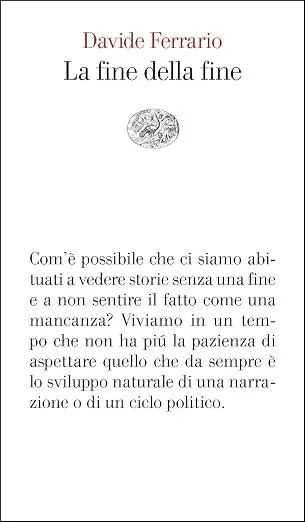
THE END OF THE END
by Davide Ferrario, read in October 2026
Writing these notes without the book in front of me can be hard; a good exercise in memory, but hard. I can't quote passages. I have to get to the heart of what stayed with me.
Davide takes the long way round. He starts with cinema, then the twentieth century: mass narratives with defined times and places, where the author—or the story, anyway—spoke from beginning to end, and the audience listened from beginning to end. If there was a story, then there was a narrative arc, and an attentive, focused audience.
Then something happened: first television, then the remote control; first radio, then the Walkman. We moved from leaving the house and going somewhere to have an experience (cinema, theatre, music, art exhibitions, cabaret) to bringing those experiences into our homes.
Here Davide recalls Fellini's insight: “We are guests in the home of that gentleman who is eating his pasta while the film is on.” Fellini, I discover, came up with the slogan “You don't interrupt an emotion,” used in the campaign for a referendum to ban commercial breaks during films. A referendum won by those who thought it was better to interrupt, to fragment.
I don't blame Italians. Once we'd got used to TV, remote controls, VHS, DVDs, streaming—with their growing convenience and ever larger catalogues—the interruption of emotion stopped being the problem.
Today we stop and pick things up again without even asking ourselves whether it makes sense. Put like that, it sounds like a dangerous consequence of modernity.
The author says that losing a single, uninterrupted viewing experience weakens the film's story. He gives the example of his niece watching 2001: A Space Odyssey and calling it “nice.”
“What did you think of 2001: A Space Odyssey?”
“Nice.”
He blames this on fragmented viewing. I'd add that the film belongs to another era. Maybe it doesn't speak to young people today the way it spoke to young people back then, when Kubrick made it. Anyone watching it now has already encountered hundreds of stories by writers who watched 2001, loved it or hated it, and absorbed or rejected its conventions. I don't see it only as a question of fragmented attention, but also as the ordinary ageing of novelty. A distorted guitar doesn't surprise us anymore; neither does an AI becoming self-aware. We file the latter under current affairs more than science fiction.
From there the author moves to a problem I feel too: the end of the end. He says that the democratisation of viewing and the end of a top-down imposed schedule seemed like freedom, but turned into an even worse kind of servitude.
Instead of being in the hands of cinema owners and producers, we're in the hands of PLATFORMS and their very dangerous ALGORITHMS. Stories no longer need to teach us anything; they have to entertain us, create engagement on platforms, and keep exposing us to advertising. The idea of never-ending stories would then be a way to tie viewers to a profile that, put like this, seems extremely crude: if you watch the Avengers, I'll serve you the Avengers saga, with prequels, sequels, parallel stories, spin-offs about minor characters, and so on.
For me, it's different.
Maybe it was different for him too. Recalling it from memory, I may have misunderstood some of the book's points.
It's not that evil platforms are directing everything. There's a natural human tendency that digital technology amplifies today. Think of mythological tales, or even commedia dell'arte and puppet theatre: those stories were endless too. Same characters, same settings, same dynamics told over and over; different stories. What now seems new—the constant search for a cliffhanger that pulls me into the next episode—was already there in serialised novels published in newspapers and magazines. Think of The Three Musketeers, The Count of Monte Cristo, or even War and Peace.
What's different today? What makes us—or me—object to series? Maybe the problem isn't structural, but numerical. At one point the author says, “They used to make 300 films a year.” Those were human-scale numbers. Commedia dell'arte performers improvised, but audiences saw only a few shows a year. Myths were retold with small variations; they were rituals repeated over centuries. The desire to find out what happens next played against a life with few narrative stimuli.
Cinema arrives with its own duration, modelled on theatre. Mechanical music follows the length of its medium and of a concert. There is nothing pre-industrial that makes the hero's journey a natural way to tell stories. The only natural part of this approach is a sequence, repeatable forever, in which a hero has a problem and solves it. Digital media make it possible to multiply the supply. As if the town square had performers there 24/7, endlessly carrying on the stories of Harlequin and Columbine.
It's not the absence of an ending that frightens us. We have always known that every story could contain infinitely many others within it. The allure of One Thousand and One Nights lies in this awareness. What terrifies us is being alone in a sea of meaningless stimuli, seeing—with mortal eyes—a glimpse of the “Library of Babel” and being overwhelmed.
Comments
Public comments stay visible here. Private messages go only to me.
Loading comments...
Comment submission will be enabled after the anti-bot check is configured.
Direct XMPP contact: manuel@bananascivolare.net